
German traffic laws: the essentials for driving in Germany (2026)
Germany rewards disciplined drivers: clear rules, robust enforcement, and—yes—selected Autobahn sections without a general speed limit. If you’re planning a road trip or simply want to understand how traffic law works here, this guide cuts through the noise with up-to-date, practical rules plus handy examples and links.
Core principles you’ll feel on day one
German road traffic is governed by the Straßenverkehrs-Ordnung (StVO) and the Road Traffic Act (Straßenverkehrsgesetz, StVG). The golden thread is responsibility: adapt your speed to conditions, keep your vehicle under control, and anticipate others. Civil liability after a crash can depend on how prudently you drove—especially at very high speeds.
Quick-read rule highlights
- Drive on the right; overtake on the left only. Keep right except when passing.
- Default limits: 50 km/h in built-up areas and 100 km/h on rural roads, unless signed otherwise.
- On Autobahns without posted limits, 130 km/h is the recommended speed (Richtgeschwindigkeit)—exceeding it isn’t an offense by itself, but it can affect liability after an accident.
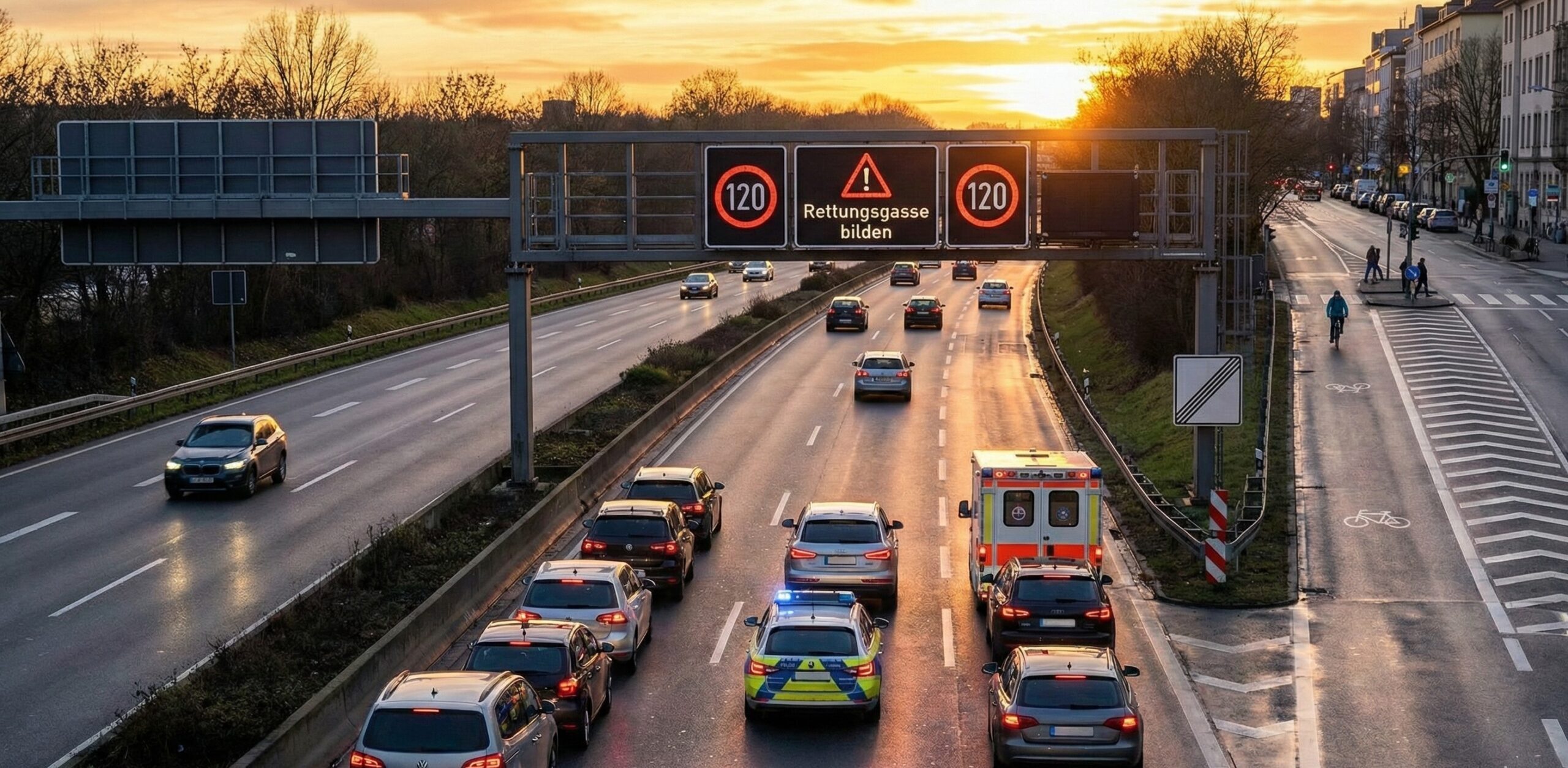
- Rescue lane (Rettungsgasse) is mandatory whenever traffic slows to a standstill on multi-lane roads: far-left lane moves left, all others move right to open a central corridor.
Speed limits (and how they’re enforced)
The vast majority of German roads have explicit speed limits or fall under the standard 50/100 km/h defaults. Motorways often use variable limits for weather and congestion, and construction zones are tightly enforced. Where no limit is posted on the Autobahn, treat 130 km/h as prudent guidance and always drive to the conditions—visibility, traffic, surface, and your car’s capability. Fixed and mobile cameras, including section-control in some regions, are common.
Fines & points: Germany uses a national points register in Flensburg. Speeding, tailgating, or blocking the rescue lane can add points, trigger fines, and lead to temporary bans; the exact tariff depends on the severity and context.
Right of way, priority, and etiquette
Priority-to-the-right applies at unsigned intersections. Pedestrian crossings and cyclists receive strong protection; failing to yield or passing too closely draws stiff penalties. On the Autobahn, lane discipline is serious business: keep right, maintain safe following distances, and never stop on the hard shoulder except for emergencies.
Alcohol, drugs, and zero-tolerance rules
The general BAC limit is 0.5‰, with 0.0‰ for novice drivers (probationary period) and drivers under 21. Sanctions escalate with BAC and repeat offenses. Drug impairment is policed actively; current federal guidance also addresses THC thresholds in road traffic assessments. When in doubt, don’t drive.
Mandatory kit, emissions, and seasonal rules
Many cities operate Low Emission Zones requiring an appropriate emissions badge on the windshield; driving without one means a fine. For safety equipment, carry a warning triangle and at least one high-visibility vest; winter tires are mandatory “as conditions require” (snow, ice, slush). Local signage can add city-specific rules.
What to pack in the car
- Reflective vest(s) and a warning triangle; use both if you must stop on the shoulder.
- Valid license (IDP recommended if your license isn’t in English or German), registration, and insurance documents.
- Winter gear when temperatures drop—Germany enforces situational winter-tire rules.
Parking, cities, and environmental zones
Urban parking is tightly regulated. Watch for residents-only zones, time-limited bays, and digital meter apps. Many city centers combine pedestrian areas, cycling priority streets, and 30-km/h districts. If you’re entering a Low Emission Zone, make sure your car qualifies and displays the correct sticker.
The Autobahn: freedom with responsibility
Germany’s most famous roads reward smooth, precise driving. Build speed gradually, scan mirrors frequently, and respect distances—closing speeds can be extreme. If you want to sample a well-maintained, high-performance car on appropriate tires and insurance, consider Autobahn-ready rentals and structured experiences that bring the legal and safety pieces together.
- Plan a legal high-speed run with Autobahn car rental packages from DRIVAR (includes fully-comprehensive insurance details on offer pages).
- Prefer a focused machine? Browse Porsche rentals across Germany to match performance to conditions.
- Want closed-course training first? Try DRIVAR’s race-track driving experiences to sharpen skills in a controlled environment.
Penalties and liability: what happens after a mistake
German law balances administrative penalties (fines, points, temporary bans) with civil liability. After a collision, the vehicle holder and driver can both be liable under the Road Traffic Act depending on fault and circumstances—especially if excessive speed contributed to risk. That’s another reason the 130-km/h recommendation matters even on de-restricted Autobahn stretches.
FAQ: German traffic law, answered
Do I need an emissions sticker for every city?
If a city has a Low Emission Zone, you need the correct badge to enter it with most vehicles. Requirements vary by city, so check before you go.
Is speeding legal anywhere on the Autobahn?
Some segments have no posted limit, but 130 km/h is the official recommended speed, and you must always adapt to conditions. Enforcement is strict where limits are posted.
What exactly is the rescue lane, and when must I form it?
On multi-lane roads when traffic is stopped or crawling, move left if you’re in the far-left lane; all others move right to create a central corridor—do it automatically, not just when sirens approach.
What’s the legal alcohol limit?
0.5‰ for standard drivers, and 0.0‰ for novice drivers and those under 21. Penalties escalate quickly—best is zero alcohol if you’ll be driving.
Can tourists rent a sports car and drive legally fast?
Yes—bring the right license/IDP, understand insurance, and follow the rules. DRIVAR’s Autobahn and track experiences are tailored for international visitors.









About Post Author

