
10 Essential Autobahn Driving Tips for Beginners & International Drivers
Driving on the German Autobahn is thrilling when you know the rules. These 10 practical tips explain—in clear English—how to stay safe, relaxed and compliant, including how to deal with advisory speed 130 km/h and modern driver assistance.
10 tips for safe Autobahn driving
The Autobahn works because consideration and predictability match high speeds with discipline. Keep right, use the left lane mainly for overtaking, and don’t camp there. Plan lane changes early, signal clearly and use the acceleration lane to reach the speed of flowing traffic—no more, no less.
Germany has many sections without a general speed limit, but an advisory speed of 130 km/h applies widely. It’s not mandatory, yet it sets a safe reference and may matter for liability after an accident. Pay attention to variable signs, roadworks and situational limits; modern systems reduce limits proactively in rain or heavy traffic.
Maintain distance (two‑second rule as a minimum), form an emergency corridor in slow traffic and stay in the car during traffic jams. Break your trip into focus blocks of 20–30 minutes with short relax phases—fatigue is the Autobahn’s silent risk. Defensive, forward‑looking driving unlocks the magic of the Autobahn without the stress.
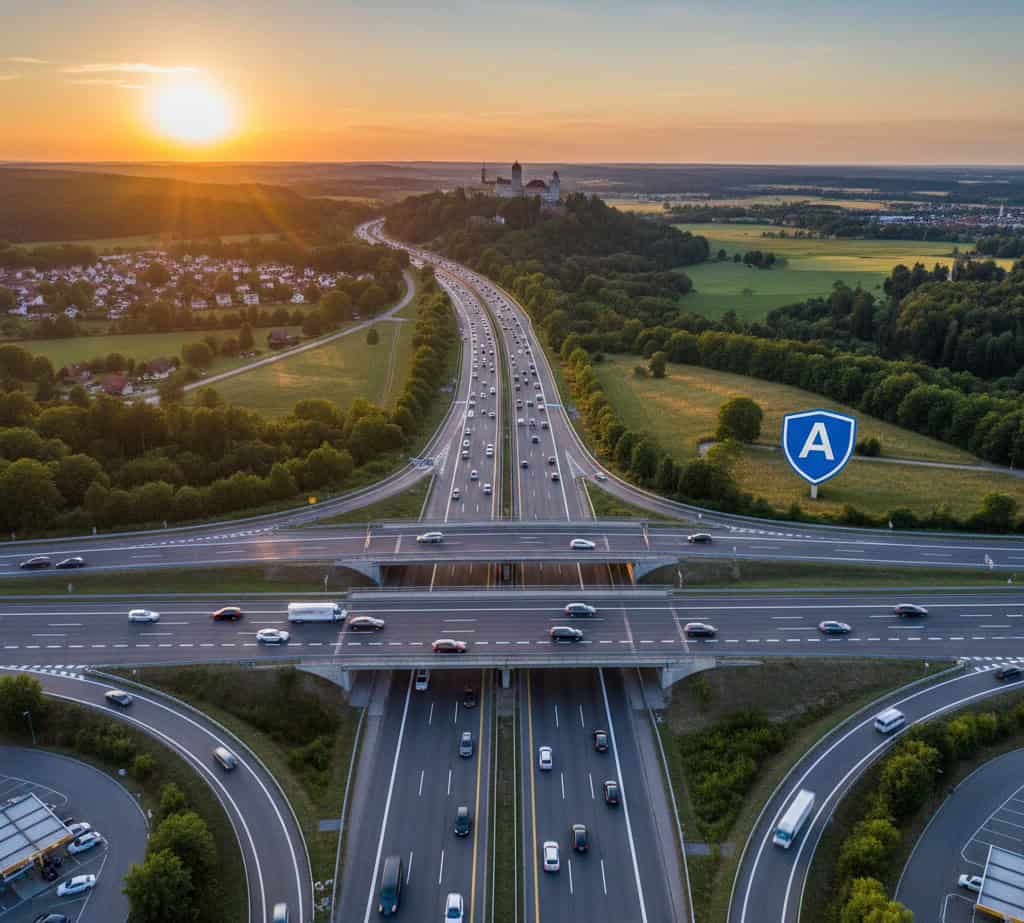
Get going safely, arrive confidently
Keep right, overtake left: Stay in the right lane as your default. Use the left lane almost exclusively to pass—and move back right promptly afterwards. This keeps traffic smooth and leaves room for faster vehicles.
No passing on the right: Overtaking on the right is forbidden; the only exception is slow‑moving traffic with clear lane offset. Be patient and pass on the left with ample space and a clearly indicated maneuver.
Keep a safe distance: At 130 km/h and above, stopping distances grow fast. As a rule of thumb, use at least the “half‑speed in meters” guideline—or better, the two‑second rule. Increase the gap in rain, snow or poor visibility.
Create the emergency corridor: As soon as traffic slows, leave a lane free between the leftmost and the immediately right lane. Do this early, not only when traffic has stopped. The hard shoulder stays clear.
Merge using the zipper rule: On the on‑ramp, accelerate decisively to the speed of the right lane and merge at the end using the zipper principle. Never use the hard shoulder; clear signaling and eye contact ease tight spots.
Observe limits and variable signs: Not every section is “no limit”. Digital signs for congestion, rain or construction are binding. Drive proactively, adjust speed and expect quickly changing signposts.
Overtake with foresight: Only pass when you can complete the maneuver briskly and without lane‑weaving. Signal early, check mirrors and blind spot and don’t cut into someone’s safety gap.
Hard shoulder is off‑limits: Use the shoulder only in emergencies. In case of breakdown: hazard lights on, put on a high‑vis vest, set the warning triangle, wait behind the barrier and call for help. Do not walk on the carriageway.
Attention at the end of a jam: If traffic slows abruptly, activate hazards early, brake smoothly and keep enough space. Don’t block gaps in the queue—the emergency corridor must remain open at all times.
Plan breaks, avoid stress: High speeds tire you out quickly. Stop at least every two hours to drink and stretch. Arriving relaxed is safer—and rarely slower—than trying to “make up minutes”.
Use tech & navigation wisely
Modern driver assistance is invaluable—if you know how to use it. Adaptive cruise control stabilizes speed and distance, lane centering reduces effort on long straights and navigation apps warn about jams, incidents or crosswinds. Assistance helps, but it is not autopilot; you remain responsible at all times. The advisory speed of 130 km/h is a legal recommendation in Germany.
EV drivers should plan charging along the route and use recuperation smartly. For performance cars, do a quick pre‑drive check: tire pressures (cold vs. warm), fluids and brakes. A small routine, a big effect.
Facts & figures
| Metric | Value |
|---|---|
| Advisory speed on Autobahn | 130 km/h (recommendation) |
| Sections without general limit | ≈ 70.4% of the network |
| Dynamic traffic control | ~10% of network with variable limits |
| Overtaking principle | Keep right, pass left |
| Emergency corridor | Create early when traffic slows |
| Following distance | At least 2 seconds |
Sources: ADAC position on speed limits in Germany; German “Richtgeschwindigkeit” regulation.
Rent your Autobahn experience
With DRIVAR you can choose from verified vehicles all across Germany—from everyday electric tourers to high‑performance supercars. Booking is transparent: pick your car, select the insurance package, sign the handover protocol—done. If you’re new to the Autobahn, start with moderate power and consider an instructor briefing.
For Autobahn stretches, quality and safety matter most: vetted partners, proper tires, clear deposits and optional delivery to hotel or airport. That leaves your head free for traffic and speed choice.
Your Autobahn drive awaits
Verified cars, clear terms, optional delivery—start your German Autobahn adventure with confidence.
FAQ: 10 Autobahn driving tips
Short & clearThe most common questions from first‑timers and international guests—answered briefly.
Many sections have no fixed limit, but plenty of areas have permanent or dynamic restrictions. The advisory speed is 130 km/h; always drive only as fast as visibility, traffic and signage allow.
As soon as traffic slows: vehicles on the leftmost lane move left, all others move right. Keep the hard shoulder free and create the corridor before emergency vehicles appear.
Generally no. Exceptions apply in slow‑moving traffic when the left lane is clearly slower. When in doubt: adjust speed, keep right and only pass on the left when a safe gap opens.
Adaptive cruise for distance control, lane keeping for straight‑line support and traffic sign recognition. Still: hands on the wheel, eyes far ahead—assistance doesn’t replace attention.
Yes, if you want to enjoy the Autobahn without driving yourself. A chauffeur handles navigation, pace and etiquette—ideal after long‑haul flights or for business trips.
Request a chauffeur








About Post Author
